
An agent that closes without you.
Most inbound dies in the gap between a customer asking and somebody answering. This closes that gap and then keeps going on its own.
It runs the whole conversation.
Your customer messages at three in the morning. The agent reads it, waits the way a person who is awake but busy would wait, and answers in the language they opened in.
Then it keeps going. It answers the follow up question, takes the objection, quotes the real number back, sends the signup link and books its own check in for Thursday. Nothing gets parked in a queue for you.
The instinct with a chatbot is to give it an escape hatch to a human. That escape hatch is where the sale dies, because it becomes the answer to every hard question. This does not have one by default.
Eleven languages, a demo thread in each. Pick one to play it. The live desk has also answered French and Portuguese, because customers wrote in them.
Whichever business appears in a thread is the setup the demo was written for, not a niche the agent is limited to. The build is the same every time; what changes is the facts, the voice and the rules you give it.
Play any of the four, or pick a step to jump to it. Hover over the thread, or press on it, to pause it while you read.
Eleven, and it does not announce the switch.
Russian, Arabic, English, Thai, Hindi, Spanish, Turkish, Uzbek, Persian, Italian, German. Detection runs on a classifier rather than a guess at the alphabet, so a Russian speaker typing in Latin characters still gets Russian back.
It writes the way somebody who grew up with the language writes. Sentence length a person would use, the local way of saying a number, no translated stiffness. Arabic and Persian render right to left properly, which sounds obvious until you see a tool that does not.
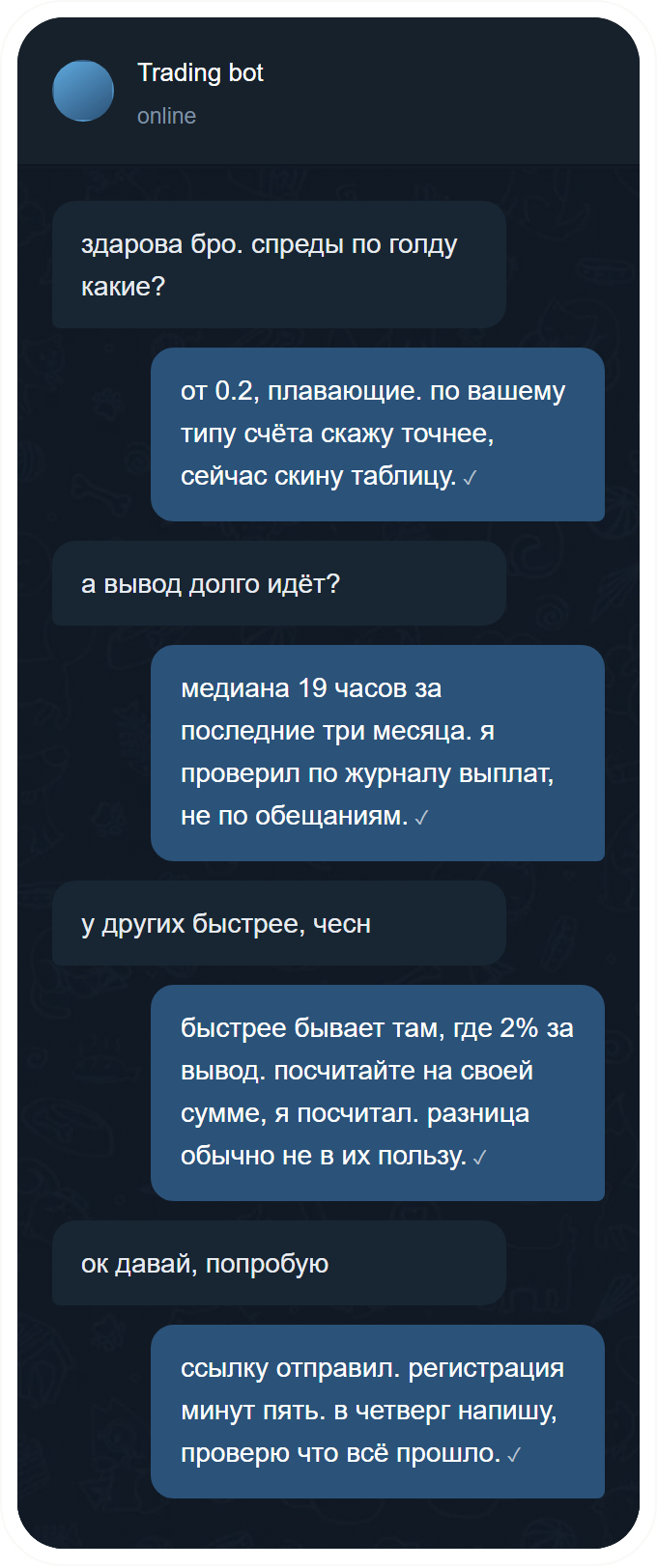
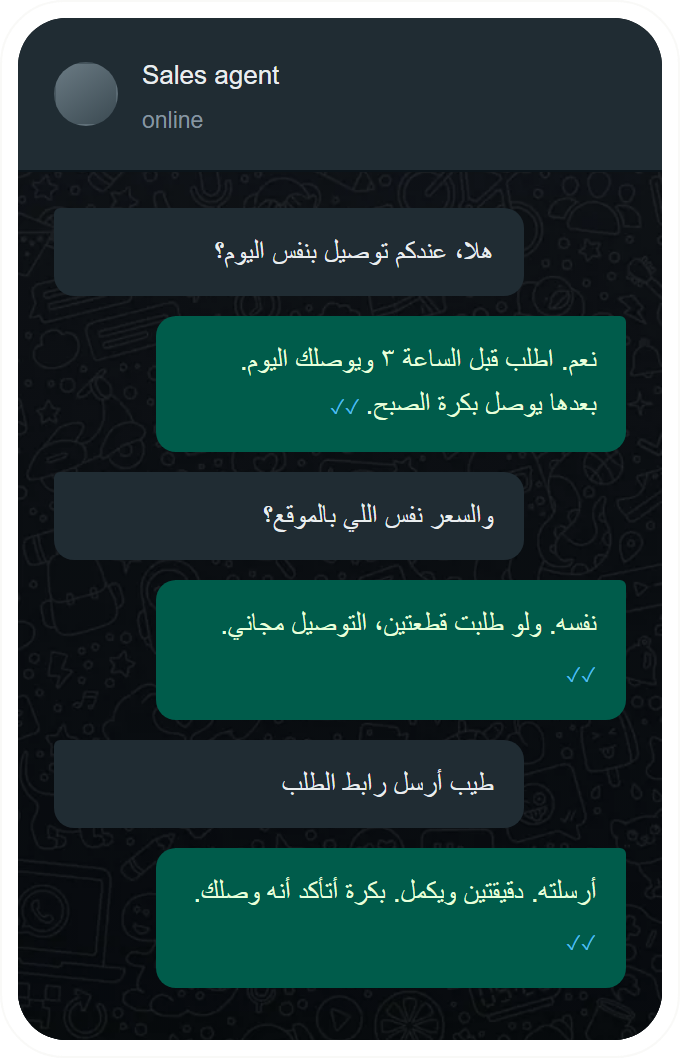
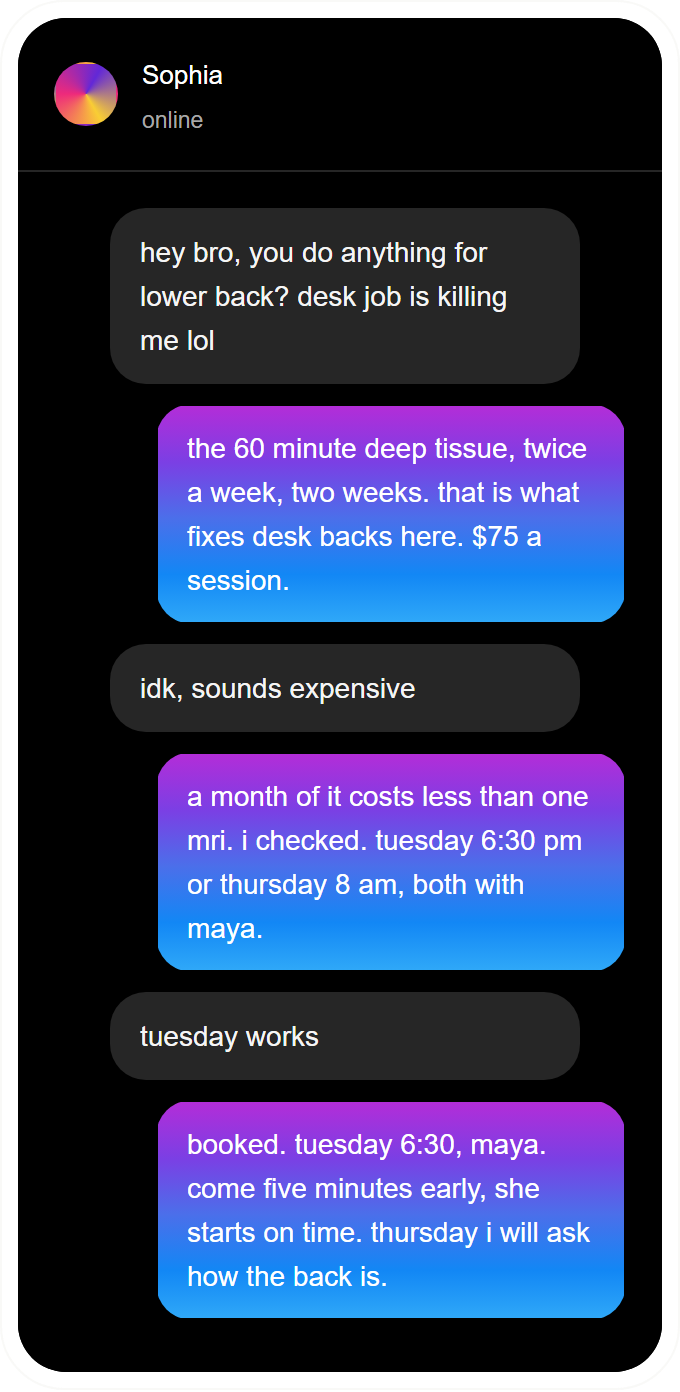

Three in the morning, and the only thing awake is the thing that answers.
It finds out who is worth your time.
Deposit intent, timing, budget, which regulator they need, whether they are already somewhere else and what would make them move. It gets this out of a conversation rather than a form, because nobody fills in a form at three in the morning.
Tyre kickers get a real answer and stop there. That is the point. You are not paying for volume, you are paying to not read the other ninety percent.
- What they came for
- Gold spreads, floating
- Objection raised
- Withdrawal speed, and a competitor said to be faster
- What actually moves them
- Total cost of a withdrawal, not the headline spread
- Stage reached
- Signup link sent and accepted
- Next contact
- Thursday, set by the agent in the same message
- Handed to a human
- Not by default
It chases the ones who go quiet.
Most inbound is lost on day two, not day one. Somebody asks a question, gets an answer, gets busy, and nobody ever writes again.
Follow up runs on its own schedule and paces itself like a person, not like a CRM. Different gap each time, different opening, and it stops when a human would stop rather than nagging into a block.
- Day 0
The link, and a named day
It sends the signup link and says when it will check back. Not "soon", an actual day, because a promise with a date on it is one you can be held to.
- Day 3
The check it promised
Same thread, no fresh pitch. Did the signup go through, did anything get stuck. Most replies come here.
- Day 8
A different angle
New opening, new reason to answer. Never the same message twice, because the second identical nudge is what gets a number blocked.
- Day 14
It stops
A person would stop here, so it stops here. The thread stays open if they come back, and they often do.
Monday
Thursday
Tuesday
The things people actually ask.
Does it ever hand over to a human?
What happens when it does not know something?
Can it use my tone?
Where does it run?
How long until it is live?
Put one on your inbound for three days.
Three days of real transcripts tell you more than I can.
Replies within hours. A real answer about your case, not a pitch.